Tuesday, August 28, 2012

Potential Backers Lose Interest in TAPI

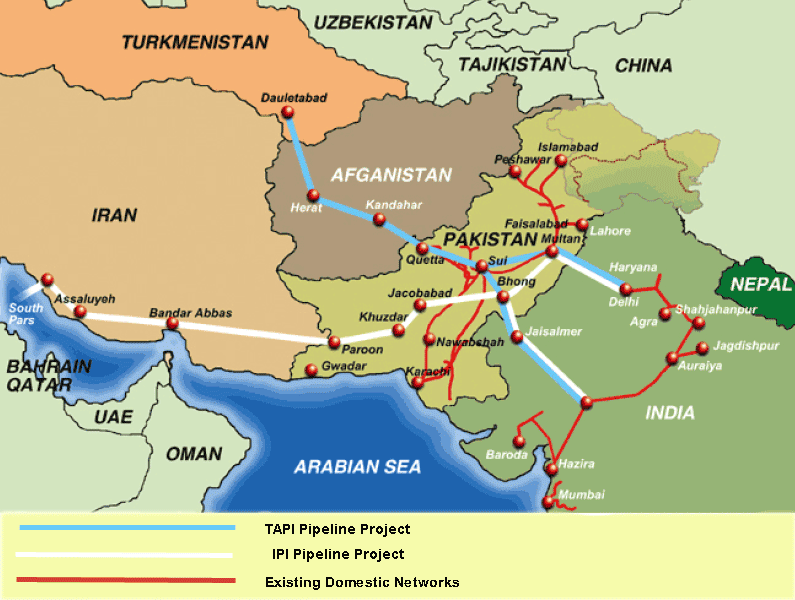
Despite support from both the United States and the Asian Development Bank, potential investors are backing away from the proposed Turkmenistan-Afghanistan-Pakistan-India (TAPI) natural gas pipeline.  This proposal has been beset with concerns over security of the pipeline route, which passes through some of the most violent prone provinces in Afghanistan.

In the latest development, China has expressed new interest in Turkmen gas.  First, Chinese President Hu Jintao has proposed a new pipeline route that would bring Turkmen gas to China via Afghanistan.  The benefit of this latest proposal is that the pipeline route would traverse a safer route in Northern Afghanistan.  Second, China also signed in May 2012 an agreement with Turkmenistan to increase deliveries through the East-West Gas Pipeline from 30 bcm  per year to 65 bcm.  This pipeline does not pass through Afghanistan, has no security isues, and has been relatively trouble free since it opened in 2009.  Finally, China has assured Turkmenistan that its demand for natural gas will constantly increase over the next five years.  As a result, Turkmenistan's enthusiasm has "softened" for TAPI, according to Pakistani correspondent Iqrar Haroon.

The Russian National Energy Institute has recommended the Russian government should avoid investing in TAPI because of security concerns, and questions over the viability of the project.  According to the Indian Institute for Defence Studies and Analyses, the proposed increases in Chinese purchases of Turkmen gas will have a negative impact on Russia.  Turkmenistan offers lower-priced gas to China, bringing downward pressure on Russian gas prices.  Russia and China have been in talks since at least June 2009 to import 68 bcm of gas per year, but have not been able to agree on a price.

Monday, August 27, 2012

Trans Adriatic Pipeline Receives Funding Commitment

The Trans Adriatic Pipeline (TAP), the southern competitor for carrying Caspian gas from the Turkish border to Europe, has received an economic boost.  British Petroleum and Total have signed an agreement with the State Oil Company of Azerbaijan (Socar) to fund the pipeline, designed to bring natural gas to Italy.   (The proposed Nabucco West would carry gas from the Turkish border to Baumgarten, Austria).  "These funds will contribute toward continued work in several important areas during the period running up to the final routing decision, expected in 2013," said a TAP spokesman.

Kjetil Tungland, TAP's managing director, issued a statement, "The signing of this agreement is a significant vote of confidence in the quality of TAP's technical and commercial solutions from key industrial players, and underpins the cooperation agreement that was signed between TAP and Shah Deniz in June."

While the Shah Deniz consortium has not yet decided between TAP and Nabucco West, TAP's chances have been improved by both the funding, and by the pipeline obtaining government support.  Both the Greek and Italian governments have agreed to support the pipeline, something they previously had not done.  According to the Greek Foreign Ministry, Greek Deputy Energy Minister Makis Papagergiou and his Italian counterpart reached a "close cooperation agreement" to support the pipeline.  The Italian Foreign Ministry added, "Athens and Rome have decided to back the project after Aszerbaijan's Shah Deniz 2 consortium chose TAP to transport gas to western Europe.  Nabucco West remains an alternative..."

With the Shah Deniz consortium sitting on the fence, other interested parties are also trying to cover all their bets.  the European Commission, which had previously said that Nabucco was a priority European project, has backed away.  It now says that it does not favor any project or route over another, as long as it carries Azeri gas, would diversify EU supplies, and would reduce EU dependence on Russian resources.  Similarly, BP is trying to support both TAP and its rival, Nabucco West.  "Our aim is to be involved in all aspects of the project so the aim is to be involved in Nabucco and TAP as well, and this is still being negotiated," BP spokesman Toby Odone said.

Wednesday, August 22, 2012

Gazprom May Punish Hungary for Supporting Nabucco


Faced with Hungary's approval of an environmental permit for the construction of the Nabucco pipeline, Gazprom may be considering moving west the route for the rival South Stream pipeline. 

Reinhard Mitschek, managing director of Nabucco, announced on August 14 that Hungary was the first country to issue the project all its permits.  "The granting of this permit is a substantial step forward in Hungary and signifies the advanced stage of development of Nabucco West," he said. 

Within a week, Gazprom announced they were in talks with Croatia over the South Stream pipeline route.  "An intergovernmental agreement between Russia and Croatia on joint participation in the South Stream project was signed in 2010," a spokesman commented.  "Currently, based on the results of a pre-investment stage, Gazprom and Plinacro Ltd. are discussing the terms of a shareholder agreement for a joint compnay project with a view to its subsequent establishment."

The Croatian side is optimistic.  "At the moment the chances are 50:50 that we get the transit route of South Stream," said a source involved in the Gazprom negotiations.  The reasons for changing the route are uncertain.    According to the Voice of Russia, a Croatian list serve, Jutarnji, listed a number of possible concerns:  lower costs, differences between Gazprom and the Hungarian leadership, uncertainty over ownership shares of various Hungarian companies, and slow work on the Hungarian economic feasibility stateement.  Gazprom's board chairman Alexei Miller minimized these reasons, however, calling them "not significant."  An unnamed Plinacro source added that there could be no official confirmation on the status of the talks, as both sides are bound by a mutual confidentiality pledge.

Timing would indicate the talks are retribution for Hungary's cooperation with South Stream's rival, Nabucco.  Whether the talks will result in the route change, or are merely a pressure tactic on Hungary by Gazprom officials, is yet to be seen.

Friday, July 13, 2012

Major Powers Supporting TAPI

Despite the obvious security problems surrounding the potential route of the Turkmenistan-Afghanistan-Pakistan-India (TAPI) pipeline, major regional and international powers are supporting the project.  According to independent Indian energy analyst Saurav Jha, the United States is supporting the project to isolate Iran from regional integration efforts, and to showcase the potential of the American "New Silk Road Initiative."  Secretary of State Hillary Clinton held a Foreign Ministerial meeting in September 2011 with all of Afghanistan's neighbors to announce the launch of this effort, designed to bring economic development and political stability to the area.

Russian interests appear aligned with the US (although they differ on the rival Iran-Pakistan-India pipeline).  In both cases Russia is offering to participate in the construction of the line.  On the subcontinent itself, the Indian Gail Ltd company signed in May an agreement with Turkmenistan to purchase TAPI gas.  (Kabul signed a memorandum of understanding, but did not sign a formal agreement).

State Gas Systems of Pakistan also signed a purchase agreement in May.  Pakistani President Asif Ali Zardari sent a message to Turkemn President Gurbanguly Berdimuhammadov stating the construction of TAPI was "essential" and the start of a new era of cooperation, according to Trend.az.   Zardari identified the pipeline as a major project:  "Pakistan is considering the construction of the Turkmenistan-Afghanistan-Pakistan-India (TAPI) gas pipeline as a major project, which is the beginning of a new era of cooperation at the regional and interregional levels."

There is little chance of TAPI being constructed until after the United States and NATO withdraw their troops from Afghanistan in 2014, and the Afghan government shows it has the ability to maintain security of the proposed pipeline.

Nabucco West Wins Semi Finals

Nabucco West, the European remnant of the EU supported Nabucco pipeline, has been chosen by the Shah Deniz 2 consortium as their potential northern route.  The original Nabucco pipeline, now known as Nabucco classic, was shorn of its length in Azerbaijan and Turkey by the intergovernmental approval of the TANAP pipeline.

The victory of Nabucco West is not a small one.  The lead investor in Shah Deniz 2 is British Petroleum, and BP had their own pipeline proposal:  the South East Europe Pipeline (SEEP).   Nabucco West was probably able to secure the consortium's support because it has transit approvals from the countries through which it would run; SEEP had not advanced beyond the concept page.

"The Nabucco West project, with a route running from the Turkish-Bulgarian border to Baumgarten (in Austria) has been selected as the single pipeline option for the potential export of Shah Deniz Stage II gas to Central Europe,"  BP announced.

Nabucco welcomed the news.  Reinhard Mitschek, managing director of Nabucco Gas Pipeline Internation, issued a statement that, "This decision is an important milestone for the Nabucco project and a major step towards the final investment decision."

While Nabucco West has been chosen as the consortium's choice for a route to Central Europe, the consortium has also picked the Trans Adriatic Pipeline (TAP) as their choice for a delivery route to Southern Europe.  Nabucco will chose in 2013 whether the gas will go north or south.  So, the semifinals in this competition are over, and the final competition will face off Nabucco West and TAP.

EU Energy Commissioner Guenther Oettinger did not take a position on which route was preferable.  "With this pre-selection, we are a step closer to getting gas directly from Azerbaijan and other countries in the Caspian region.  Whatever the final decison on the whole route from the eastern part of Turkey to Europe, Azerbaijani gas is certain to come to Europe," he wrote.  "This is a success for Europe and for our security of supply."

Wednesday, July 11, 2012

Higher Priced Gas Not Detering South Stream

Faced with competition from TANAP, Nabucco-West, LNG and alternative fuels, Gazprom is coming to grips with lower anticipated revenues from their proposed South Stream pipeline.  Sergei Komlev, head of price formation for Gazprom Export, believes Europe will buy the gas anyway.  In June, he told the World National Oil Companies Congress in London, "Our estimate is that the difference (between hub-priced gas and South Stream supplies) is $2 per million British thermal units," according to Reuters.  Komlev said the price would be attractive because Gazprom would provide South Stream gas via long-term contracts, which would provide more security of supply than spot-priced hub gas.

Revenues will suffer, however, because of price breaks to various countries.  As an example, to keep Bulgaria in the South Stream consortium, Gazprom has agreed to an 11% price discount for the upcoming year, a loss of USD 115 million.  Bulgarian Economy and Energy Minister Delyan Dobrev gave the results of these negotiations to reporters in June.  "Currently, there is no danger of Bulgaria not participating in South Stream," he said.  "We support the South Stream project.  We believe it is profitable for Bulgaria, but we have to specify all the details."

While Dobrev is pleased with the negotiations, there is a question as to whether Bulgaria can finance its share of the pipeline.  According to an unconfirmed source, Gazprom might pay for the Bulgarian section of the pipeline and then repay itself by deducting the gas transit fees the company would otherwise owe the country.  Regardless of the financing, South Stream has begun the Environmental Impact Statement for the 250 kilometer section that will run off the Bulgarian Coast, according to the Sofia News Agency.

South Stream has also recruited a new member of the consortium, Macedonia.  According to Macedonian Vice Premier and Minister of Finance Zoran Stavreski, membership will secure gas supplies for future generations of Macedonians, although the country was not originally considered for membership.  "This was in fact done (through a myriad of contacts and high-ranging talks) from a position where there were no plans to be included in the project," he said.  "There is no more dilemma--Macedonia is joining the international gas pipeline corridor 'South Stream' as it has been agreed between PM Nikola Gruevski and President Vladimir Putin.  We've received the text of the draft-agreement."

Russian President Putin continues to remain optimistic toward the project, and in June said the pipeline could begin natural-gas flows as early as 2014.  This would inaugerate the pipeline years before the Nabucco-West rival, which is scheduled for completion in 2017-2018.

Tuesday, July 10, 2012

TANAP Signed Amid Russian Threats

On June 27, 2012, Turkey's Prime Minister Recep Tayyip Erdogan and Azerbaijan's President Ilham Aliyev signed the long-awaited agreement to construct the TANAP pipeline.  This 2,000 kilometer natural gas pipeline will link the Shah Deniz 2 gas field in the Caspian with Turkey's western border.  The original design is for the pipeline to carry 16 bcm of gas annually, of which 6 bcm is for the Turkish domestic market.  SOCAR (State Oil Company of Azerbaijan) will own 80% of the pipeline, with the remaining 20% divided between the Turkish pipeline companies BOTAS (Turkish Petroleum Pipeline Corporation) and TPAO  (Turkish Petroleum Corporation.)  The project is estimated to cost approximately $7 billion, and is scheduled for completion in 2018.

The two signators called the intergovernmental agreement "historic."  Other observers were equally impressed.  Mahmut Mucahit Findikli, head of the Turkish parliament's energy committee, told SE Times, "This is not only a very optimal way to meet European gas diversification needs, but also very important for our country as it increases Turkey's role as a transit country."  Charles University's Caspian energy expert Jan Sir noted the project "Keeps alive the stategic rationale" for a southern energy corridor to provide Europe with non-Russian gas.  "For Azerbaijan, it opens new export opportunities and provides the desired diversification of external relations and stable income...With the opening of the Caspian to the West, Turkey's Caucasus connection would become stronger and Russia would lose much of its influence over the post-Soviet region."  World Energy Council's Hilal Pataci issued a warning, however, that the agreement could turn into a "problem in Russia-Turkey relations in the upcoming years."

Pataci's warning has been echoed by Gazprom, the Russian government-owned gas company.  In response to a Turkish request for additional Russian gas (because of an explosion halting imports on the Iran-Turkey pipeline), Gazprom graciously agreed and noted the company has been a dependable supplier.  It warned, however, that if TANAP were completed in 2018, "Turkey could then apply for help to Baku."

One has to wonder, however, how much impact a mere 10 bcm per year of natural gas will have on Gazprom's European monopoly.  The amount represents only about 2% of European gas consumption.